
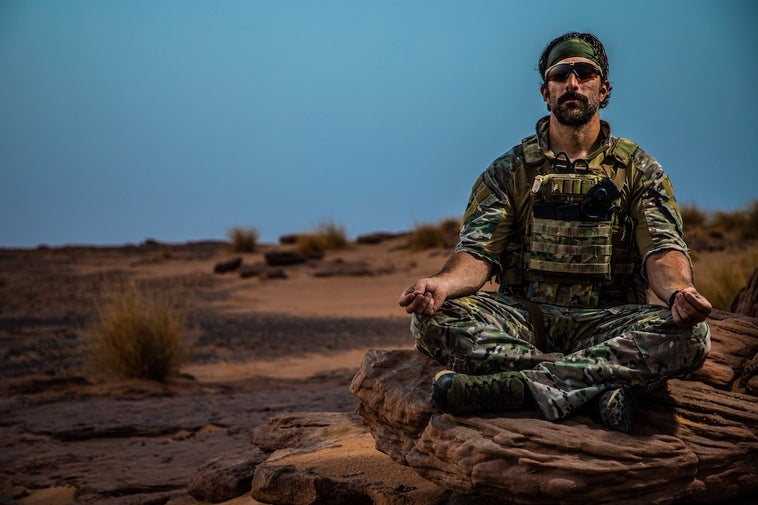
A Decade On: Why We’re Still Using Yoga
Although it’s now a common feature in many training programs, when SOFlete first started up, there weren’t many other tactical strength and conditioning companies period, let alone those integrating yoga into their training. However, from day 1, we found it to be a valuable tool for both improving performance and enhancing health and injury resilience.

Some ten years later and still a mainstay in our training programs, yoga is associated with a ton of health benefits, from stress relief to improved breathing mechanics. However, probably the reason that most people choose to at least start to undertake yoga regularly, is that it increases range of motion.
But why is this relevant to you as a tactical professional? Well, we know from the scientific research into this area (as you probably do just intuitively), that limited range at a joint can increase the risk of injury, especially if there’s a big difference between left and right sides.
But it’s probably not for the reason you think.
An awesome Physiotherapist I was fortunate enough to work for, whilst in the Royal Air Force, once told me that “...muscles are just stupid chunks of meat. They simply do what they’re told by the nervous system.” in the same way that within a computer, the hardware is controlled by the software. Consequently, if a muscle is ‘tight’, we shouldn’t be asking “how do I stretch this muscle so that I can increase my mobility?”, instead we should be asking “why does the nervous system deem it needs to restrict range of motion in that muscle, or at that joint?”; and this is where things start to get really interesting.
In order to fully appreciate this divergence from the mainstream perspective, we need to first consider that, as the boss of you, the nervous system is only really interested in survival. It doesn’t care how fast you can sprint 100m or how heavy you can deadlift, it just wants you to be able to not die in the process. With that in mind, if the nervous system perceives something as a threat to this survival, it’ll turn on the ‘limp home mode’ to varying degrees- just like your car if the onboard computer detects a fault. Given that really all muscles can do functionally is to contract and relax, the nervous system’s primary means of damage limitation are by restricting force production (an interesting topic for another article), and/or, what’s more relevant to our discussion- limiting your mobility.
An easy example you can try now to illustrate this is to stand up and touch your toes. Take note of how far down your shins you can get your hands, or if you’re already quite mobile, how flat you can get your hands to the floor. This will be our baseline.
Now perform 10 aggressive, shallow breaths in through your mouth, pulling your shoulders up towards your ears with each breath, clenching your fists hard the entire time.
Now re-test that toe touch; if you’re like most people you should notice that you have instantly been robbed of some mobility- that’s because the nervous system perceived the shallow breathing as an indicator of threat and applied the limiter.
Next, stand back up, squeeze your glutes and put one hand just below your belly button. Take 10 slow, deep nasal breaths, trying to expand your belly into your hand with each breath. On each breath, think about extending out the exhale and relaxing your whole body (especially your face and neck) as much as you can. Then once again perform that re-test. You should notice a significant increase in range of motion compared to that last test, and probably an increase over the initial test too- that’s how quickly and effectively your nervous system can make very real changes to your performance.
This is where, and why, activities like yoga can be so useful. Rather than just aimlessly static stretching, playing tug of war with tight muscles and becoming increasingly frustrated; think about using things like breathing and visualization to help you relax as much as you can whilst in the flow. This in turn will provide a soothing, ‘’this is safe’’ signal to the nervous system which will unlock more range of motion.
If you’re interested in giving something like this a go, check out the guided yoga flows we have in the Mobility Team on the SOFlete app.
Additional Content:
-
Yoga Breathing is Science, Not Hippie Nonsense (https://www.youtube.com/watch?v=ldCAZ02jANA)
-
Why Tough Folks Should Do Yoga (Part 1) (https://www.youtube.com/watch?v=QYhv3SivDe0&t=17s)
-
Why Tough Folks Should Do Yoga (Part 2) (https://www.youtube.com/watch?v=oIU67zb-bh4)



Leave a comment
This site is protected by hCaptcha and the hCaptcha Privacy Policy and Terms of Service apply.